Art Portfolio: Akasthe Kaikyo and Chang-hua–Kao-hsiung Viaduct bridge research
Today, I finally got the dimensions of the Dnister River from the Infrastructure Restoration and Development Service in the Chernivtsi Region. The length is 175 meters, which means the bridge should be 200-210 meters. The river's depth varies depending on the season from 3 to 10 meters, meaning the piers should be 12 meters estimated from the river bottom.
The main problem was that my previous design wouldn't work with such dimensions. They were designed to be 100 meters long and at least 50 meters high because the Dniester River is deep water. But especially in shallow water.
So, I needed to create a new design, and the main problem was that I couldn't improve any of the previous sketches that I had created. In these circumstances, I should do absolutely something new because the conditions are definitely different than I thought. However, the one positive thing is that within these conditions, the design is easier to create. The longer the bridge, the fewer design possibilities you have.
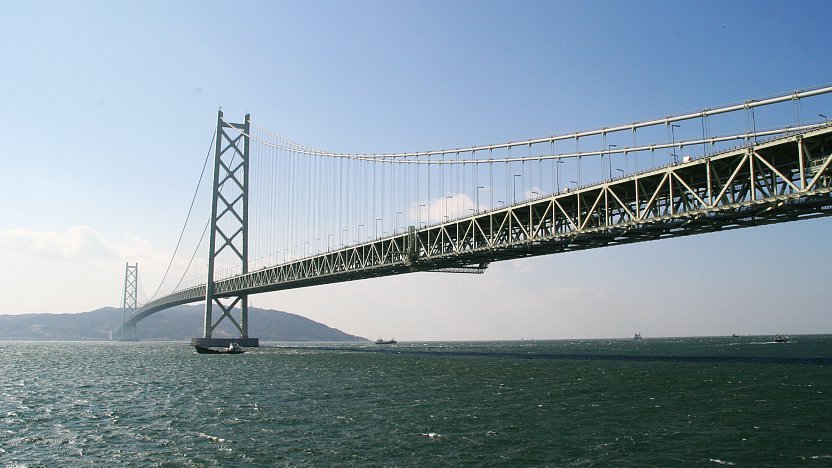
With my little experience and knowledge, the only possibility that I have is a suspension bridge construction like the Akashi Kaikyo Bridge that was placed in Honshu and Awaji, Japan.

Akashi Kaikyo Bridge
Another option is the Chang-hua–Kao-hsiung Viaduct bridge design that is placed in runs from Zouying in Kao-hsiung to Baguashan in Chang-hua County.

Chang-hua–Kao-hsiung Viaduct
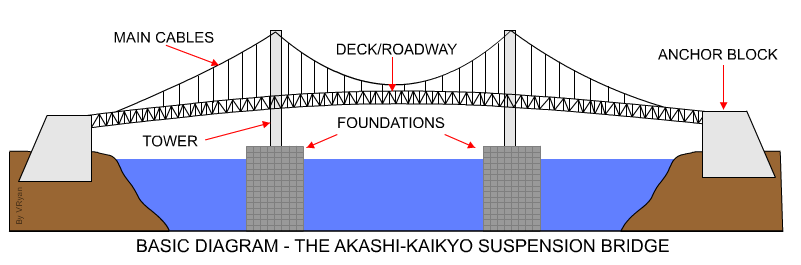
Akashi Kaikyo Bridge have a main tower construction and they are connected with main cables; because of this system, construction is stable."A suspension bridge carries vertical loads through curved cables in tension. These loads are transferred both to the towers, which carry them by vertical compression to the ground, and to the anchorages, which must resist the inward and sometimes the vertical pull of the cables." (Britannica,2019). An example of this is possible to see below.

suspension bridge
(A suspension bridge, with forces of tension represented by red lines and forces of compression by green lines.)

The Akashi-Kaikyo Suspension Bridge diagram
The only difficult aspect is if the territory contains soft soils or sand; then there is a need to use bored piles up to 40 m long to achieve a dense layer. The Akasthe Kaikyo Bridge used nearly 60 m bored piles. However, the territory where my designed bridge will be placed needs just 10-15 m because the solid is hard and the height above the water is not that high.
Chang-hua–Kao-hsiung Viaduct is a rail bridge, but the process of this construction is very easy. A large number of piers placed at a close distance helps distribute the load evenly. This technique was used for ages and tested by age. For me this design is more suitable. I prefer the guarantee that everything will be safe and sustainable - this is a main aspect of my project.
In my next sketch, I will try to insert this type of pier because I like how they look and the construction aspect possible to insert into my design and location.
Reference:
“Akashi Kaikyo Bridge.” Institution of Civil Engineers (ICE), 2024, www.ice.org.uk/what-is-civil-engineering/infrastructure-projects/akashi-kaikyo-bridge. Accessed 21 Feb. 2025.“Seismic Resistant Viaduct Design for the Taiwan High Speed Rail Project.” Lusas.com, 2025, www.lusas.com/case/bridge/taiwan.html. Accessed 21 Feb. 2025.
“Chang-Hua–Kao-Hsiung Viaduct | Bridge, Taiwan | Britannica.” Encyclopedia Britannica, 2025, www.britannica.com/topic/Chang-hua-Kao-hsiung-Viaduct. Accessed 21 Feb. 2025.



Okay there is some thoughts and commentary here and it does link to your work
ReplyDelete